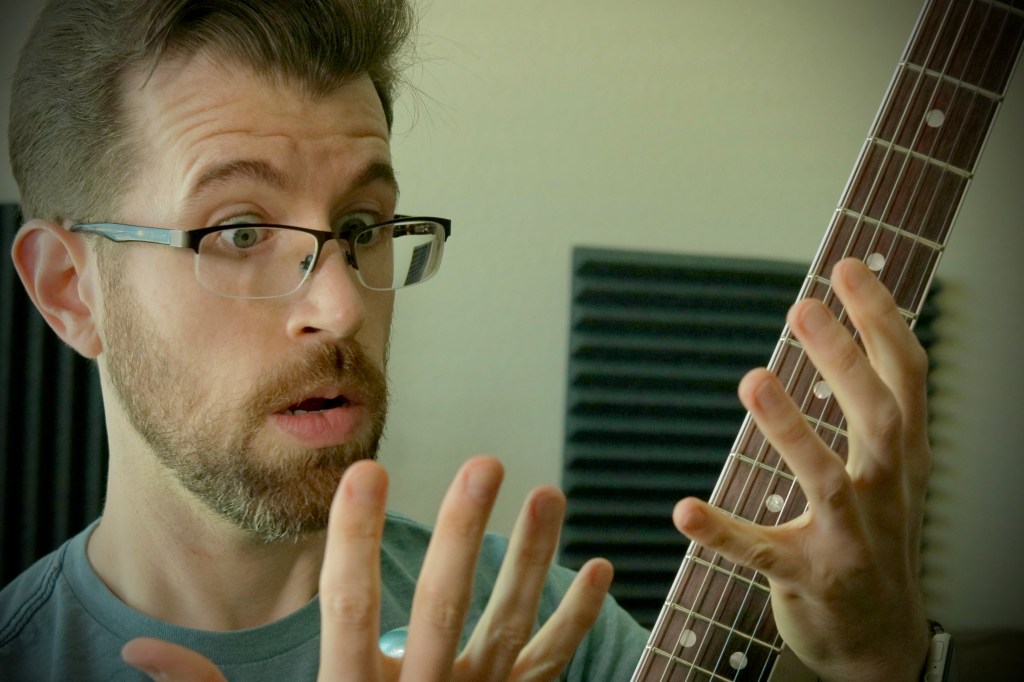
Does a guitar player’s tone come from their fingers? Or does tone come from the right combination of guitars, amps, and pedals?
While these seem like sensible questions, they are the wrong questions for most players to ask. Guitar tone is not a simple matter of gear or technique. Tone starts with your ears and what you perceive as “good.”
The way you use your fingers (technique) and your preferred equipment are definitely part of the equation. Any discussion of where tone comes from will include some version of these two ideas:
- Tone MUST be in the fingers. [Famous player] could play a beginner guitar through a practice amp and still sound great.
- Tone is NOT in the fingers. [Famous player] wouldn’t sound that way if they played a different guitar with a different amp and pedals.
These ideas both have merit. But they fail to acknowledge how different musicians hear music. Let’s discuss where tone REALLY comes from.
What Is Guitar Tone?
“Tone” is a vague term that means different things to different people.
Does tone include techniques like vibrato, sweep picking, or two-handed tapping? What about things like economy of motion and posture? Or are we only talking about equipment?
Tone is all of these things and more.
A guitar player’s tone is the result of developing opinions about different elements of sound and choosing which to use and which to discard.
The tone of an electric guitar is the sum of hundreds of choices guided by the player’s individual preferences and influences. Jimi Hendrix sounded the way he did because he liked certain sounds more than others.
Jimi chose a Fender Stratocaster as his main guitar. He chose Marshall amps (at least for a time). He chose high-capacitance coiled instrument cables and effects pedals built or modified by Roger Mayer.
He also liked the sound of certain chords, licks, and rhythms.
Great players build their signature tones because of three factors:
- What sounds good to them
- What works for them
- What is available and convenient
This is true for equipment and techniques. If a player doesn’t like the sound of a certain combination of notes, they won’t play them very much. If you can’t stand the way a Stratocaster feels in your hands, you will probably want to play something else.
The Elements of Guitar Tone
While skill and technique are absolutely essential to getting a great sound, it’s absurd to claim that tone is purely subjective.
Single-coil pickups don’t sound like humbuckers. A Floyd Rose doesn’t sound like a Bigsby vibrato.
No matter how much you practice, no technique can replace the sound of chorus, phaser, or delay effects. This is even more true for pitch-shifting effects like a DigiTech Whammy or an Electro-Harmonix POG Poly Octave Generator.
These are examples where tone is NOT in the fingers. But it still depends on your ears and musical instincts to decide if they sound good.
Certain guitars are better suited for particular styles of music. A guitar with humbuckers is better for high-octane metal solos than a vintage-spec Fender Telecaster. A Bigsby vibrato is better for rockabilly than a Floyd Rose.
If you’re unhappy with your guitar tone, consider whether your troubles have roots in the following categories.
1. Pickups
When your guitar tone is too thin or too muddy, the first thing most guitar players want to change is the pickups. And for good reason.
Pickups take the physical vibrations from your strings and turn them into weak electrical signals. These signals are amplified by your amp.
If you know what you want to change about your guitar tone, swapping your pickups can be like adding a permanent EQ pedal or signal booster. If your rig sounds too bright, a darker-sounding pickup can give your amp’s built-in EQ more flexibility. A muddy guitar rig can spring to life with a brighter set of pickups.
A tube amp that breaks up too much at low volumes might benefit from a guitar with lower-output pickups. Conversely, you might want higher-output pickups if you want to push your tube amp harder.
In general, pickups with less output will have a brighter, cleaner signal. More output means less treble and more midrange.
Pickups with ceramic magnets typically provide a brighter tone with higher output, but they lack the warmth of a vintage-style pickup with Alnico magnets.
The aftermarket guitar pickup industry is HUGE.
Beyond the big names like Seymour Duncan, DiMarzio, TV Jones, and EMG, there are a huge number of boutique and specialty pickup makers. These include Lindy Fralin, Lollar, Curtis Novak, and Dylan Pickups.
Each company offers pickups with varying specifications, materials, and levels of craftsmanship. There so many choices that it might be wise to consider other modifications first.
2. Controls/Electronics
The control layout and the electronics used in your guitar can have a huge impact on the signal coming out of your pickups.
Some guitars, like a Gibson Les Paul or SG, have individual volume and tone controls for each pickup. A Fender Telecaster has one volume and one tone control that affect both pickups.
The exact control layout will dictate whether you certain modifications will change the sound of one pickup or all if the pickups.
If your guitar is too bright or too dark, you might consider changing the pots. Pots with lower resistance (250K or 300K) allow more treble to “leak” out of the circuit. This is ideal for bright single-coil pickups.
Higher pot values like 500K or 1Meg help retain more of your pickup’s frequency range. This is great for darker-sounding pickups like humbuckers or even P-90s.
Another modification that can alter your guitar tone is trying different capacitor values on your tone control(s).
Many modern guitars use 0.022 µF capacitors. Higher values, like the 0.1 µF and 0.047 µF caps found in vintage Fenders, will roll off more treble as you turn the tone knob. Lower values, such as 0.015 µF or even 0.0022 µF, have a more subtle effect.
Different capacitor values will also interact with your pickups differently. Rolling back a tone control not only removes treble but also creates a “resonant peak” that’s similar to a wah-wah pedal left in a fixed position. This can be fun to experiment with, especially on a guitar with independent tone controls for each pickup.
There are also plenty of advanced wiring options. These can include phase switching, wiring pickups in series or parallel, coil splitting, and various tone circuits (i.e. treble bleed, a Jaguar-style “strangle” switch, or a Gretsch tone switch). A word of warning: many electronics-savvy guitar players install too many toggle switches or push-pull pots in a guitar and never use them.
3. The Bridge
We usually think about bridges affecting things like tuning stability and intonation. But they can affect tone, too.
Anyone who has owned a guitar with a low-quality Floyd Rose licensed bridge knows how much a bad bridge can ruin an otherwise decent instrument. They have terrible sustain and make the tone overly bright. Guitars equipped with a real Floyd Rose unit, or a high-quality Floyd Rose licensed bridge, have plenty of sustain and balanced tone.
In general, a bridge with more mass will have more sustain and less effect on the tonal balance of the strings. Bridges made from low-density or poor-quality materials will dampen the string vibration.
Changing bridges can get expensive and may not have the effect you were hoping for. Unless your current bridge needs replacement anyhow, this can lead down a deep rabbit hole.
But if your guitar lacks sustain, upgrading the bridge might solve the problem.
Setup
Never underestimate the value of a good setup. If your action (how high the strings sit off the fretboard) is too high, you’ll have to press the strings harder. This could make it difficult to play fast riffs or big bends. Low action can cause buzzing
Gear Can’t Replace Practice
As I write this article, I have been playing guitar for over 20 years. Like many guitarists, I went through various phases of trying to sound like my favorite players.
My first guitar was a white Stratocaster copy. I went through several fuzz pedals before arriving at a Roger Mayer Classic Fuzz. Even with a reissue Vox Clyde McCoy wah-wah, I never sounded like Jimi Hendrix.
I tried different pickups. Different amps. Different string gauges. I still sounded like myself.
Trying various Ibanez Tube Screamers did not make me sound like Stevie Ray Vaughan. And acquiring a Gretsch 6120 didn’t help me play or sound more like Brian Setzer.
As boring as it sounds, practice is the only thing that has helped me sound more like my guitar heroes.
What should you practice? Whatever pleases your ears.
Often, we try to separate the sound of the instrument from the person wielding it. No matter how close we get to replicating Jimi’s gear or technique, the result will always feel empty without Jimi holding the guitar.
No amount of guitars, amps, and pedals can help you develop your musical instincts. Learning scales, chords, and arpeggios and knowing which ones you like is worth more than memorizing a bunch of cool licks. And knowing when to turn down the treble will improve your tone more than an $800 fuzz pedal.
Choose equipment that sounds good and suits your needs. Invest in education instead of a new guitar. TrueFire has helped me keep GAS at bay more than once.
Conclusion
Tone is in the ears.
Your fingers (technique) and gear are tools that help you create sounds that make you happy. While plenty of factors can make a guitar sound better or worse to your ears, there is no accounting for taste.
Copying your favorite guitarist’s licks and gear choices won’t have the same effect as finding gear and techniques that sound good to your ears. The unique combination of your favorite sounds and techniques is what makes you sound like yourself.
The exception to all of these conclusions is if you’re the guitar player for a tribute band. Then, by all means, nail that sweet David Gilmour tone, or buy every pedal Jimi Hendrix ever used.
 Mike Eiman
Leave a comment