Proper intonation can make a bad guitar into a good one. And it can make a good guitar sound great.
Imagine this: You spend several minutes fiddling with your guitar until each string is perfectly in tune. You strum a G chord and everything sounds great. Then you play a chord higher up the neck and all that tuning goes out the window.
What the heck is going on?
Assuming your guitar is holding tune, the most likely explanation is a problem with your intonation. But what is intonation?
In short, intonation describes how in tune your guitar is all the way up the neck. Intonation can be adjusted by shortening or lengthening the strings to ensure the notes on each string align with the frets.
There are several ways to adjust the intonation on most electric guitars. If you suspect your guitar has bad intonation, keep reading.
How Do I Know If My Guitar Needs Intonation?
As mentioned above, the most obvious symptom of bad intonation is chords and single notes becoming more out of tune as you go up the neck.
If you’ve recently switched to heavier or lighter string gauges, or the weather got really hot or cold, your intonation may have suffered.
The fastest way to check if your intonation is bad is to tune your guitar and play an open E major chord. Does it sound in tune? Now move the fretted notes up an octave. Strum the chord as you normally would, playing the higher notes in combination with the open strings. If it sounds good, your intonation is probably fine. If it sounds bad, your intonation is probably bad.
In most cases, only two or three strings will be out of whack. Here’s an easy way to check the intonation of each string:
- Tune your guitar. Use an electronic tuner if possible, or use another instrument with reliable reference pitches. Get all six strings as close to perfect tuning as possible.
- Fret the low-E string at the 12th fret. Check your tuner. It should be as perfectly tuned as the open string. You will need to adjust the intonation if the note is more than a few cents sharp or flat.
- Repeat Step 2 for the other strings. Be sure to recheck the open strings periodically to ensure they are still in tune.
What should you do if one or more strings are poorly intonated? Keep reading.
How Do I Fix My Guitar’s Intonation?
Unless your guitar was poorly built, you can almost always fix bad intonation.
A rare defect of cheap or heavily modified guitars is that the bridge is installed in the wrong place. This means no amount of adjustment can correct the intonation. This problem is even rarer now that most guitars are built with the help of CNC (Computer Numerical Control) machines.
Modern instruments are equipped with various features that allow minor adjustments to shorten or lengthen the strings to address intonation. In the following sections, we will cover some of these features.
Bridge and Saddles
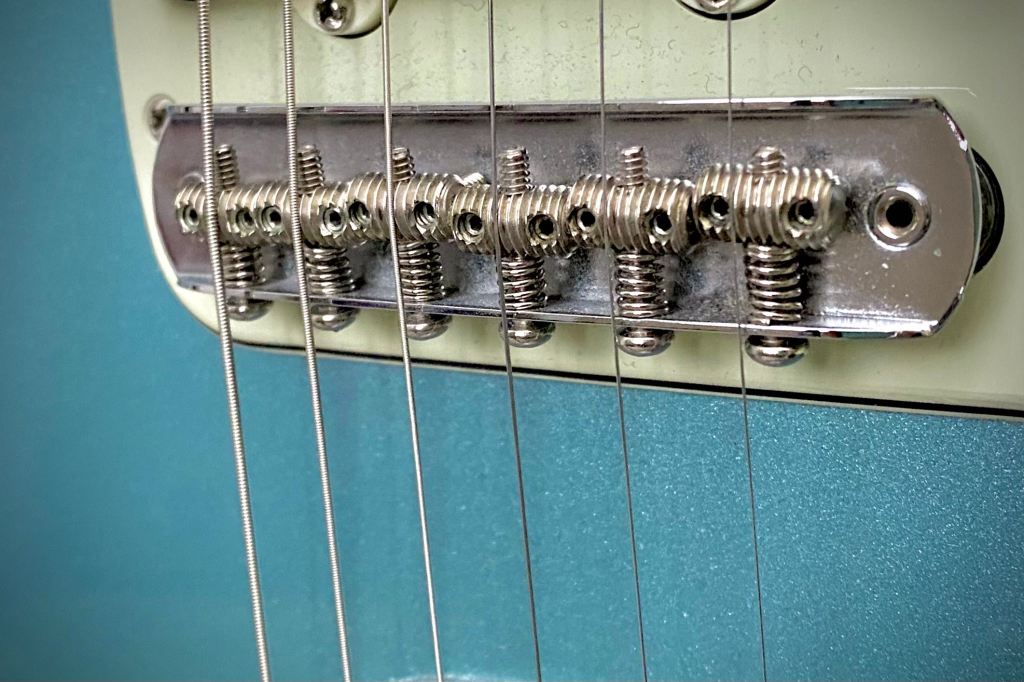
If your guitar has adjustable saddles, these will most likely be your first line of defense against bad intonation.
To understand how this works, you need to picture a harp. The longer, thicker strings are tuned to lower pitches, while the shorter thinner strings are tuned higher.
When a guitar string is flat at the 12th fret, that means the string is too long when it’s fretted at the 12th fret. To shorten the string, you would move the saddle toward the neck.
Likewise, a string that’s sharp at the 12th fret is too short when it’s fretted at the 12th fret. You would need to lengthen the string by adjusting the saddle so that it moves away from the neck. On a Fender-style guitar, this may increase the tension on the string and require detuning.
Jazz and archtop-style guitars often have movable bridges. This means the intonation can get disturbed anytime the bridge gets bumped around. Since these bridges don’t always have adjustable saddles, you may have to move or angle the bridge to get the intonation as good as possible.
Acoustic guitars have a one-piece saddle made from bone or plastic. Some acoustic guitar saddles are straight. Others are “compensated,” which means they have grooves to alter the length of the G, B, and E strings.
Nut
While poorly-cut slots in your guitar’s nut can result in bad intonation, the problem can usually be fixed by adjusting the saddles.
For instance, a bone nut can chip or crack. One of the slots could potentially become misshapen on the fretboard side. This might increase the string length and throw the intonation out of adjustment.
If your bridge or saddles don’t have enough adjustment, or you can’t stand to look at a cracked nut, you will have to fill and refile the affected slots or replace the nut entirely.
Truss Rod
While it may not seem obvious, the truss rod can also have a huge impact on intonation.
The truss rod’s main function is to set how much relief the neck has when the strings are tuned to full tension (i.e. when the guitar is in tune). Without a truss rod, the string tension would cause the neck to bow. Too much or too little neck relief can cause buzzing and choked notes at various sections of the fretboard.
Unless you have a very light touch, the neck needs a slight forward bow for the strings to vibrate freely.
When the neck bows forward due to heavier strings or changes in the weather, the nut moves slightly closer to the bridge. This shortens the strings and makes the notes go sharp as you move up the neck. Adjusting the saddles while your guitar is in this condition may result in unusual saddle alignment if your saddles have enough adjustment to correct the problem.
Even if your guitar had a professional setup a month ago, changes in weather can cause the metal and wood components (like your neck and truss rod) to expand or contract. Anything that makes the strings longer or shorter will affect the intonation.
Is Guitar Intonation Ever Perfect?
The guitar, like every fixed-tuning instrument, is always slightly out of tune. This allows the instrument to sound good in any key.
Modern fixed-tuning instruments typically use 12-tone equal temperament tuning. Equal temperament means all 12 chromatic pitches are tuned relative to a single reference pitch. The most common reference pitch is 440 Hertz, or A440, which is the A above middle C on the piano.
Since every note is based on a single pitch, some notes locate between the open string and 12th fret will be more in tune than others.
Some guitar manufacturers try to improve the intonation of their instruments by using fanned frets and different scale lengths for each string. Other solutions include the True Temperament neck, which has specially contoured frets that adjust the intonation all the way up the fretboard. Even this system isn’t perfect, but it provides moderately better intonation than a standard guitar neck.
Tuning every note perfectly would result in an instrument that has to be re-tuned to play in different keys. In the end, tuning and intonation on a fretted instrument is an act of compromise.
Conclusion
Good intonation is an essential part of any decent guitar setup. It won’t matter how expensive your guitar was if it sounds like garbage anytime you play beyond the first few frets.
When your intonation begins to suffer, your first inclination might be to fiddle with the saddles. If the weather recently changed or if you switched to different string gauges, it could be the truss rod that needs adjustment.
If you don’t feel comfortable adjusting the truss rod or the saddles yourself, find a qualified guitar tech to do the work for you. Your truss rod may need a minor adjustment once or twice a year (summer and winter). If paying someone to turn a wrench a quarter of a turn sounds absurd to you, it might be worth learning to do it yourself.
 Mike Eiman
Leave a comment